
Article Peer-Reviewed
Flying Green by Choice: A System Dynamics Forecast of Voluntary SAF Demand Integrating Policy, Market, Demographic, and Behavioral Drivers
Institute for Transport and Logistics Management, Vienna University of Economics and Business, 1020 Vienna, Austria
*
For correspondence.
Academic Editor:

Received: 13 June 2025 Accepted: 18 December 2025 Published: 19 January 2026
Abstract
This conceptual research article proposes a system dynamics-based framework to forecast the voluntary uptake of Sustainable Aviation Fuel (SAF) by air passengers departing from European Union (EU) airports. Unlike existing literature that treats policy and consumer behavior in isolation, the study integrates policy mandates, fuel price dynamics, passenger demographics, and behavioral drivers into a unified conceptual model. The framework emphasizes the role of willingness-to-pay (WTP), segmenting passengers by travel purpose and environmental attitudes. Although no empirical simulation or quantitative calibration is conducted, the model structure is designed to accommodate scenario analysis and uncertainty assessment, incorporating elements such as carbon pricing, SAF-fossil fuel cost differentials, blending mandates (e.g., ReFuelEU), and marketing effectiveness. Four illustrative scenarios (baseline, high policy support, technological breakthrough, and low WTP) are outlined to demonstrate how different assumptions may shape SAF demand trajectories. Model outputs are defined conceptually and include SAF uptake share, absolute demand, CO2 savings, and abatement cost. This study does not present an empirically calibrated simulation and therefore refrains from producing quantitative forecasts. Its contribution is a rigorously specified conceptual structure intended to guide future parameterization and validation with real-world data; thus, it is intended as a foundation for future empirical research and policy experimentation. The study is offering strategic value for airlines, SAF producers, and regulators aiming to stimulate voluntary contributions to aviation decarbonization. By outlining system interactions and key sensitivities, the study advances a holistic, behaviorally informed approach to modeling voluntary SAF demand.
Figures in this Article
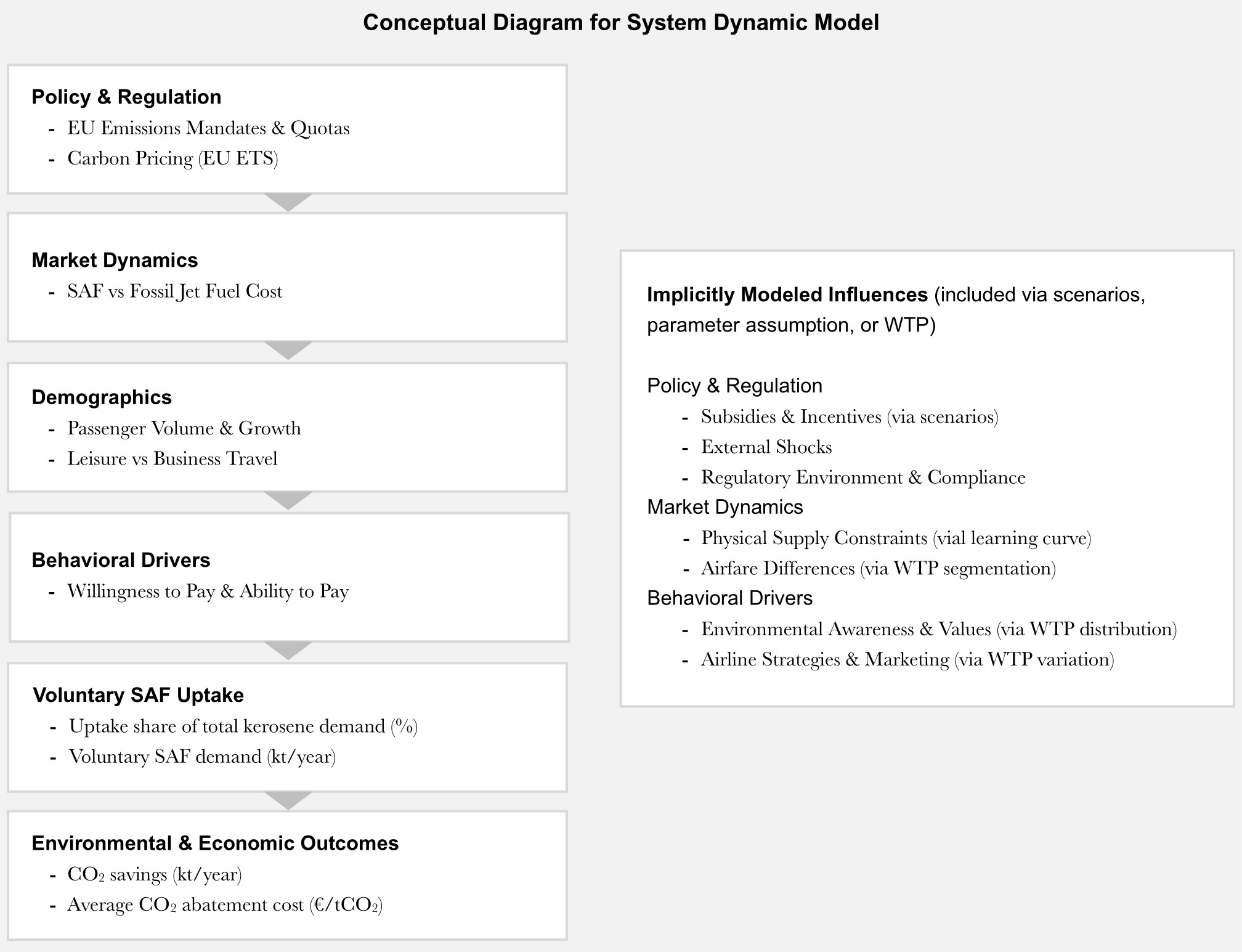 Figure 1
 Figure 2
Keywords
sustainable aviation fuel (SAF); voluntary carbon offsets; system dynamics modeling; willingness-to-pay (WTP)
Copyright © 2026
Soklaridis et al. This article is distributed under the terms of the Creative Commons Attribution License (CC BY 4.0), which permits unrestricted use and distribution provided that the original work is properly cited.
Funding
This research received no specific grant from any funding agency in the public, commercial, or not-for-profit sectors.
Cite this Article
Soklaridis, S., Reisdorf, A., & Kummer, S. (2026). Flying Green by Choice: A System Dynamics Forecast of Voluntary SAF Demand Integrating Policy, Market, Demographic, and Behavioral Drivers. Highlights of Sustainability, 5(1), 46–60. https://doi.org/10.54175/hsustain5010004
References
1.
European Commission. (2025). Reducing emissions from aviation—European Commission. https://climate.ec.europa.eu/eu-action/transport-decarbonisation/reducing-emissions-aviation_en (accessed 13 June 2025).
2.
ICAO. (25 May 2025). Trends in Emissions that affect Climate Change. ICAO. https://www.icao.int/environmental-protection/Pages/ClimateChange_Trends.aspx (accessed 13 June 2025).
3.
Medina, R. (2024). EUROCONTROL Aviation Long-Term Outlook: Flights and CO2 emissions forecast 2024 – 2050.
4.
Airbus. (25 March 2025). Airbus showcases hydrogen aircraft technologies during its 2025 Airbus Summit. https://www.airbus.com/en/newsroom/press-releases/2025-03-airbus-showcases-hydrogen-aircraft-technologies-during-its-2025 (accessed 13 June 2025).
5.
Clean Sky 2 Joint Undertaking. (2022). Towards Climate Neutral Aviation. An independent study on the socioeconomic impact of the European Union’s Clean Sky 2 Programme. With assistance of Roland Berger, Oxford Economics. CleanAviation Joint Undertaking.
6.
Rau, A., Stumpf, E., & Gelhausen, M. (2024). Modelling the impact of introducing first-generation narrowbody hydrogen aircraft on the passenger air transportation network in Europe. Journal of the Air Transport Research Society, 3, 100029. https://doi.org/10.1016/j.jatrs.2024.100029
7.
McCausland, R. (2024). Net zero 2050: Sustainable aviation fuels.
8.
European Commission. (2025). ReFuelEU Aviation—European Commission. https://transport.ec.europa.eu/transport-modes/air/environment/refueleu-aviation_en (accessed 13 June 2025).
9.
Xu, B., Ahmad, S., Charles, V., & Xuan, J. (2022). Sustainable commercial aviation: What determines air travellers’ willingness to pay more for sustainable aviation fuel? Journal of Cleaner Production, 374, 133990. https://doi.org/10.1016/j.jclepro.2022.133990
10.
KLM. (2025). SAF: Alternative aviation fuel - KLM. SAF: Alternative Aviation Fuel - KLM Austria. https://www.klm.at/en/information/sustainability/saf (accessed 13 June 2025).
11.
IATA. (2024). ReFuelEU Aviation Handbook.
12.
Reisdorf, A. (2024). The Influence of SAF on International Aviation Competition.
13.
Rains, T., Winter, S. R., Rice, S., Milner, M. N., Bledsaw, Z., & Anania, E. C. (2017). Biofuel and commercial aviation: Will consumers pay more for it? International Journal of Sustainable Aviation, 3(3), 217. https://doi.org/10.1504/IJSA.2017.086846
14.
Ahire, J. P., Bergman, R., Runge, T., Mousavi-Avval, S. H., Bhattacharyya, D., Brown, T., et al. (2024). Techno-economic and environmental impacts assessments of sustainable aviation fuel production from forest residues. Sustainable Energy & Fuels, 8(19), 4602–4616. https://doi.org/10.1039/D4SE00749B
15.
Braun, M., Grimme, W., & Oesingmann, K. (2024). Pathway to net zero: Reviewing sustainable aviation fuels, environmental impacts and pricing. Journal of Air Transport Management, 117, 102580. https://doi.org/10.1016/j.jairtraman.2024.102580
16.
Shahriar, M. F., & Khanal, A. (2022). The current techno-economic, environmental, policy status and perspectives of sustainable aviation fuel (SAF). Fuel, 325, 124905. https://doi.org/10.1016/j.fuel.2022.124905
17.
Watson, M. J., Machado, P. G., Da Silva, A. V., Saltar, Y., Ribeiro, C. O., Nascimento, C. A. O., et al. (2024). Sustainable aviation fuel technologies, costs, emissions, policies, and markets: A critical review. Journal of Cleaner Production, 449, 141472. https://doi.org/10.1016/j.jclepro.2024.141472
18.
Ahmad, S., Xu, B., Greening, P., & Ouenniche, J. (2020). Public Attitude Towards Aviation Bio-Fuels: A Pilot Study Findings. https://doi.org/10.46855/energy-proceedings-6464
19.
Chiambaretto, P., Laurent, S., Schmalz, U., Fu, M., Rouyre, A., Bildstein, C., et al. (2024). Are consumers willing to pay more for green innovations? Insights from the air transport industry. Technovation, 137, 103079. https://doi.org/10.1016/j.technovation.2024.103079
20.
Hong, S.-A., & Huh, S.-Y. (2025). Assessing the Market Viability of Sustainable Aviation Fuel: Consumer Acceptance and Willingness to Pay. https://doi.org/10.2139/ssrn.5262656
21.
Hui, T. H., Itani, N., & O’Connell, J. F. (2024). Examining Air Travellers’ Willingness to Pay for Non-voluntary Environment-related Fees: The Case of SAF Surcharge and Carbon Taxes. Highlights of Sustainability, 3(1), 61–75. https://doi.org/10.54175/hsustain3010005
22.
Chen, R., Yang, H., Wang, K., & Jiang, C. (2024). Impacts of a sustainable aviation fuel mandate on airline competition—Full-service carrier vs. Low-cost carrier. Transportation Research Part B: Methodological, 190, 103098. https://doi.org/10.1016/j.trb.2024.103098
23.
Marcuta, L., Cazacu, M., & Marcuta, A. (2023). Study on the development of the biofuel market and their future in sustainable production. Scientific Papers Series Management, Economic Engineering in Agriculture and Rural Development, 23(3), 565–571.
24.
Grimme, W. (2023). The Introduction of Sustainable Aviation Fuels—A Discussion of Challenges, Options and Alternatives. Aerospace, 10(3), 218. https://doi.org/10.3390/aerospace10030218
25.
Breen, M., Carton, J. G., & Efthymiou, M. (2025). Sustainable Aviation Fuel (SAF) Supply. In C. McNally, P. Carroll, B. Martinez-Pastor, B. Ghosh, M. Efthymiou, & N. Valantasis-Kanellos (Eds.), Transport Transitions: Advancing Sustainable and Inclusive Mobility (pp. 646–651). Springer Nature Switzerland. https://doi.org/10.1007/978-3-031-89444-2_94
26.
Malina, R., Abate, M. A., Schlumberger, C. E., & Navarro Pineda, F. (2022). The Role of Sustainable Aviation Fuels in Decarbonizing Air Transport. Washington, DC: World Bank. https://doi.org/10.1596/38171
27.
Eurocontrol. (26 January 2021). EUROCONTROL Data Snapshot on CO2 emissions from flights in 2020. https://www.eurocontrol.int/publication/eurocontrol-data-snapshot-co2-emissions-flights-2020 (accessed 13 June 2025).
28.
Lipsmeyer, C. S., Philips, A. Q., Rutherford, A., & Whitten, G. D. (2024). Bad times keep us together: Policy priorities and economic shocks. Social Science Quarterly, 105(4), 934–947. https://doi.org/10.1111/ssqu.13382
29.
World Economic Forum. (23 May 2022). Davos 2022: The world’s first energy crisis and how to fix it. https://www.weforum.org/stories/2022/05/first-global-energy-crisis-how-to-fix-davos-2022 (accessed 13 June 2025).
30.
Rutherford, D. (2021). Potential tankering under an EU sustainable aviation fuels mandate.
31.
Mayeres, I., Peduzzi, E., Alder, M., Baier, F., Buchtal, K., Chatterjee, S., et al. (2025). Assessing Policies for the Uptake of Sustainable Aviation Fuels Using the Impact Monitor Framework. Engineering Proceedings, 90(1), 95. https://doi.org/10.3390/engproc2025090095
32.
Zhou, Y., Searle, S., & Pavlenko, N. (2022). Current and future cost of e-kerosene in the United States and Europe.
33.
EASA. (2025). SAF Market. https://www.easa.europa.eu/en/domains/environment/eaer/sustainable-aviation-fuels/saf-market (accessed 13 June 2025).
34.
Sharma, B. P., Yu, T. E., English, B. C., & Boyer, C. N. (2021). Economic Analysis of Developing a Sustainable Aviation Fuel Supply Chain Incorporating with Carbon Credits: A Case Study of the Memphis International Airport. Frontiers in Energy Research, 9, 775389. https://doi.org/10.3389/fenrg.2021.775389
35.
IATA. (2024). Disappointingly Slow Growth in SAF Production. https://www.iata.org/en/pressroom/2024-releases/2024-12-10-03 (accessed 13 June 2025).
36.
Ahmad, S., & Xu, B. (2021). A cognitive mapping approach to analyse stakeholders’ perspectives on sustainable aviation fuels. Transportation Research Part D: Transport and Environment, 100, 103076. https://doi.org/10.1016/j.trd.2021.103076
37.
Kousoulidou, M., & Lonza, L. (2016). Biofuels in aviation: Fuel demand and CO2 emissions evolution in Europe toward 2030. Transportation Research Part D: Transport and Environment, 46, 166–181. https://doi.org/10.1016/j.trd.2016.03.018
38.
Xu, Y., Zhang, Y., Deng, X., Lee, S.-Y., Wang, K., & Li, L. (2025). Bibliometric analysis and literature review on sustainable aviation fuel (SAF): Economic and management perspective. Transport Policy, 162, 296–312. https://doi.org/10.1016/j.tranpol.2024.11.014
39.
EASA. (2023). EASA Report – State of the EU SAF Market in 2023.
40.
Morrell, P. S. (2021). Airline Finance (5th ed.). Routledge. https://doi.org/10.4324/9781003038191
41.
Renold, M., Kuljanin, J., & Kalić, M. (2019). The comparison of financial performance of airlines with different business model operated in long-haul market. Transportation Research Procedia, 43, 178–187. https://doi.org/10.1016/j.trpro.2019.12.032
42.
ICAO. (2024). ICAO unveils 2026-2050 Strategic Plan: “Safe Skies, Sustainable Future”. https://www.icao.int/Newsroom/Pages/ICAO-unveils-20262050-Strategic-PlanSafe-SkiesSustainable-Future.aspx (accessed 13 June 2025).
43.
RSB. (2022). SAF Sustainability Guidance for Airports: A summary of the Sustainable Airports Platform outputs in 2022.
44.
Santos, K., & Delina, L. (2021). Soaring sustainably: Promoting the uptake of sustainable aviation fuels during and post-pandemic. Energy Research & Social Science, 77, 102074. https://doi.org/10.1016/j.erss.2021.102074
45.
AMEX. (2024). SAF FAQs.
46.
Surgenor, C. (4 April 2025). Microsoft backs SAF for Scope 3 business travel emissions in agreements with IAG and FEG. GreenAir News. https://www.greenairnews.com/?p=7044 (accessed 13 June 2025).
47.
Wenzel, E. (9 May 2024). Corporations buy into sustainable fuel certificates to address air travel emissions. Trellis. https://trellis.net/article/corporations-buy-sustainable-fuel-certificates-address-air-travel-emissions (accessed 13 June 2025).
48.
Cordes, H., Baumeister, S., & Käyrä, M. (2023). Factors influencing the willingness to pay for aviation voluntary carbon offsets: А literature review. European Journal of Tourism Research, 36, 3602. https://doi.org/10.54055/ejtr.v36i.2741
49.
Moser, S., & Kleinhückelkotten, S. (2018). Good Intents, but Low Impacts: Diverging Importance of Motivational and Socioeconomic Determinants Explaining Pro-Environmental Behavior, Energy Use, and Carbon Footprint. Environment and Behavior, 50(6), 626–656. h https://doi.org/10.1177/0013916517710685
50.
Eger, C., Munar, A. M., & Hsu, C. H. C. (Eds.). (2023). Gender and tourism sustainability. Routledge.
51.
Chen, F.-Y. (2013). The intention and determining factors for airline passengers’ participation in carbon offset schemes. Journal of Air Transport Management, 29, 17–22. https://doi.org/10.1016/j.jairtraman.2013.01.001
52.
De Groot, J. I. M., & Steg, L. (2009). Mean or green: Which values can promote stable pro‐environmental behavior? Conservation Letters, 2(2), 61–66. https://doi.org/10.1111/j.1755-263X.2009.00048.x
53.
Yraola Iii, S. D., & Mendiola, A. A. (2024). The Theory of Planned Behavior and Its Influences on Willingness-To-Pay for Green Air Travel: A Values Orientation Perspective. Journal of Management for Global Sustainability, 12(1). https://doi.org/10.13185/2244-6893.1226
54.
Dioba, A., Kroker, V., Dewitte, S., & Lange, F. (2024). Barriers to Pro-Environmental Behavior Change: A Review of Qualitative Research. Sustainability, 16(20), 8776. https://doi.org/10.3390/su16208776
55.
Ebeling, F., & Lotz, S. (2015). Domestic uptake of green energy promoted by opt-out tariffs. Nature Climate Change, 5(9), 868–871. https://doi.org/10.1038/nclimate2681
56.
Kaiser, M., Bernauer, M., Sunstein, C. R., & Reisch, L. A. (2020). The power of green defaults: The impact of regional variation of opt-out tariffs on green energy demand in Germany. Ecological Economics, 174, 106685. https://doi.org/10.1016/j.ecolecon.2020.106685
57.
Rice, C., Ragbir, N. K., Rice, S., & Barcia, G. (2020). Willingness to pay for sustainable aviation depends on ticket price, greenhouse gas reductions and gender. Technology in Society, 60, 101224. https://doi.org/10.1016/j.techsoc.2019.101224
58.
Berger, S., Kilchenmann, A., Lenz, O., & Schlöder, F. (2022). Willingness-to-pay for carbon dioxide offsets: Field evidence on revealed preferences in the aviation industry. Global Environmental Change, 73, 102470. https://doi.org/10.1016/j.gloenvcha.2022.102470
59.
Araña, J. E., & León, C. J. (2013). Can Defaults Save the Climate? Evidence from a Field Experiment on Carbon Offsetting Programs. Environmental and Resource Economics, 54(4), 613–626. https://doi.org/10.1007/s10640-012-9615-x
60.
Mello, F. P. D. (2024). Voluntary carbon offset programs in aviation: A systematic literature review. Transport Policy, 147, 158–168. https://doi.org/10.1016/j.tranpol.2023.12.023
61.
Yunyoung, Y. K., & Wooje, C. (2024). The Effect of Airline’s ESG Management on Corporate Reputation, Corporate Image, and Relationship Continuance Intention. Global Business Finance Review, 29(5), 146–159. https://doi.org/10.17549/gbfr.2024.29.5.146
62.
Jachimowicz, J. M., Duncan, S., Weber, E. U., & Johnson, E. J. (2019). When and why defaults influence decisions: A meta-analysis of default effects. Behavioural Public Policy, 3(02), 159–186. https://doi.org/10.1017/bpp.2018.43
63.
Mertens, S., Herberz, M., Hahnel, U. J. J., & Brosch, T. (2022). The effectiveness of nudging: A meta-analysis of choice architecture interventions across behavioral domains. Proceedings of the National Academy of Sciences, 119(1), e2107346118. https://doi.org/10.1073/pnas.2107346118
64.
Agarwal, A., Canfield, C., & Fikru, M. G. (2024). Role of greener default options on consumer preferences for renewable energy procurement. Renewable Energy, 221, 119802. https://doi.org/10.1016/j.renene.2023.119802
65.
Ghesla, C., Grieder, M., & Schubert, R. (2020). Nudging the poor and the rich – A field study on the distributional effects of green electricity defaults. Energy Economics, 86, 104616. https://doi.org/10.1016/j.eneco.2019.104616
66.
Christodoulos, C., Michalakelis, C., & Varoutas, D. (2011). On the combination of exponential smoothing and diffusion forecasts: An application to broadband diffusion in the OECD area. Technological Forecasting and Social Change, 78(1), 163–170. https://doi.org/10.1016/j.techfore.2010.08.007
67.
Al-Duais, F. S., & Al-Sharpi, R. S. (2023). A unique Markov chain Monte Carlo method for forecasting wind power utilizing time series model. Alexandria Engineering Journal, 74, 51–63. https://doi.org/10.1016/j.aej.2023.05.019
68.
Whiteside, J. D., II, PE. (2008). A Practical Application of Monte Carlo Simulation in Forecasting. AACE International Transactions.
69.
Duque, L.-F., O’Connell, E., & O’Donnell, G. (2023). A Monte Carlo simulation and sensitivity analysis framework demonstrating the advantages of probabilistic forecasting over deterministic forecasting in terms of flood warning reliability. Journal of Hydrology, 619, 129340. https://doi.org/10.1016/j.jhydrol.2023.129340
70.
Papadopoulos, C. E., & Yeung, H. (2001). Uncertainty estimation and Monte Carlo simulation method. Flow Measurement and Instrumentation, 12(4), 291–298. https://doi.org/10.1016/S0955-5986(01)00015-2
71.
Oh, J.-H., Oldani, A., Solecki, A., & Lee, T. (2024). Learning to predict sustainable aviation fuel properties: A deep uncertainty quantification viewpoint. Fuel, 356, 129508. https://doi.org/10.1016/j.fuel.2023.129508
72.
Yang, F., & Yao, Y. (2025). Sustainable aviation fuel pathways: Emissions, costs and uncertainty. Resources, Conservation and Recycling, 215, 108124. https://doi.org/10.1016/j.resconrec.2025.108124
73.
Borgonovo, E., & Plischke, E. (2016). Sensitivity analysis: A review of recent advances. European Journal of Operational Research, 248(3), 869–887. https://doi.org/10.1016/j.ejor.2015.06.032
74.
Lopez, M., Leon, S., Kwakernaak, S., Silva, V., Posada, J., & Alvarez, O. (2024). Sustainable Aviation Fuel Production Optimization in Colombia: An In-depth Sensitivity Analysis. Chemical Engineering Transactions, 109, 337–342. https://doi.org/10.3303/CET24109057
75.
Kohavi, R., & Longbotham, R. (2023). Online Controlled Experiments and A/B Tests. In D. Phung, G. I. Webb, & C. Sammut (Eds.), Encyclopedia of Machine Learning and Data Science (pp. 1–13). Springer US. https://doi.org/10.1007/978-1-4899-7502-7_891-2
Metrics
Loading...
Sustainable Development Goals
This work contributes to the following Sustainable Development Goals (SDGs).

Journal Menu
Journal Contact
Highlights of Sustainability
Editorial Office
Highlights of Science
Avenida Madrid, 189-195, 3-3
08014 Barcelona, Spain
08014 Barcelona, Spain
Ms.
Cathy Wang
Managing Editor
