
Article Peer-Reviewed
The Impact of Climate Risk on Corporate Water Disclosure: Evidence from Water Intensive Companies in Indonesia
Department of Accounting, Faculty of Economics, University Sriwijaya, Palembang, South Sumatra, Indonesia
*
For correspondence.
Academic Editor:

Received: 21 June 2025 Accepted: 12 December 2025 Published: 19 January 2026
Abstract
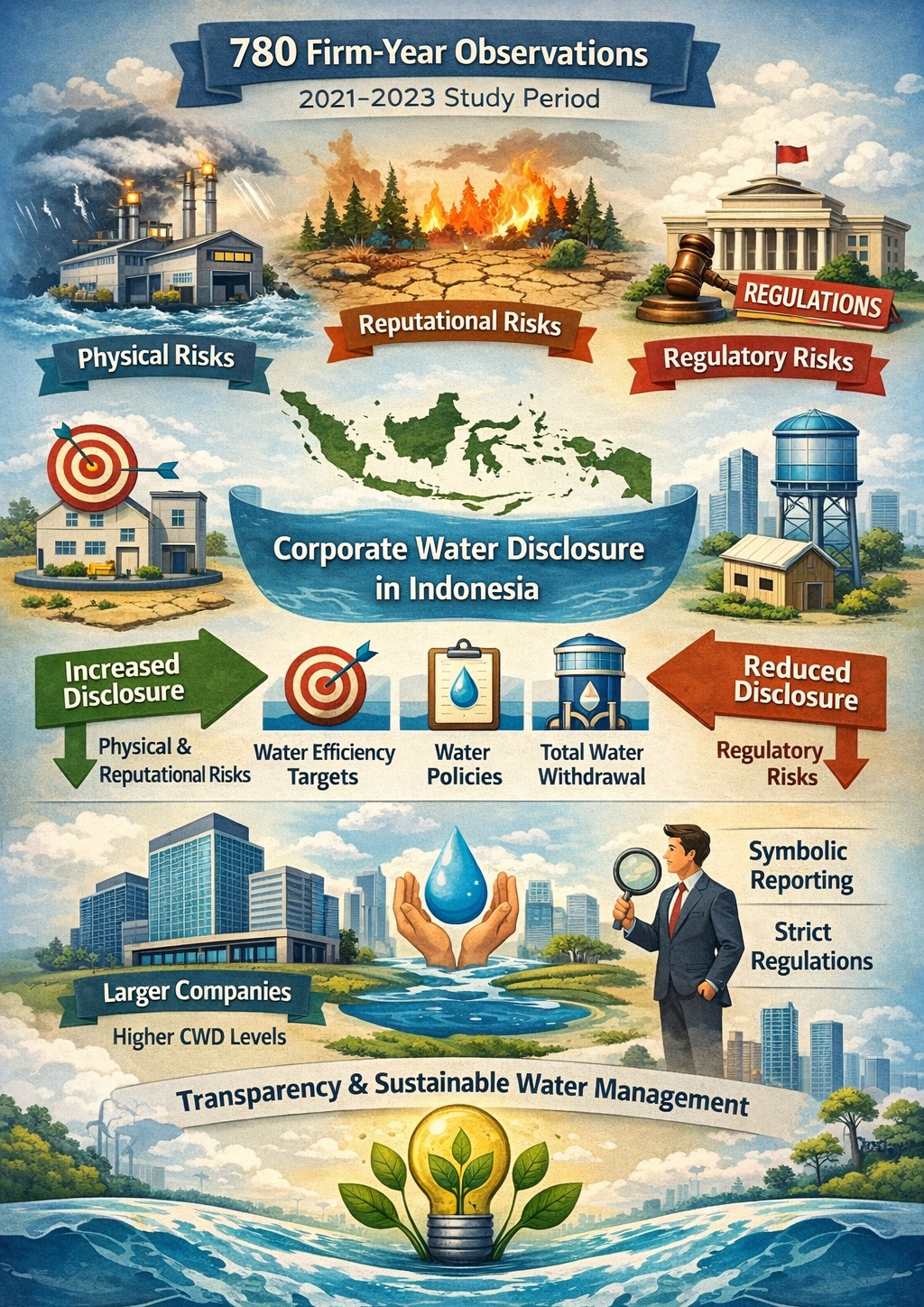
This study examines the impact of climate-related risks—specifically, physical, regulatory, and reputational risks—on corporate water disclosure (CWD) in water-intensive industries in Indonesia, one of the countries most vulnerable to the impacts of climate change. Grounded in legitimacy theory, the research explores how companies enhance transparency in water management to maintain social acceptance amid external pressures. Using 780 firm-year observations from sustainability and annual reports covering 2021–2023, this study developed the CWD index based on three leading indicators: water efficiency targets, policies, and total water withdrawal. The regression results show that physical and reputational risks positively and significantly impact the level of water disclosure. Firms experiencing operational disruptions or reputational pressure tend to enhance their disclosure efforts to sustain legitimacy. On the other hand, regulatory risk shows a significant negative relationship with disclosure, suggesting that stringent regulations may lead to symbolic rather than substantive reporting. Company size was also found to be the strongest predictor of water disclosure, affirming that larger companies have greater capacity and pressure for sustainability reporting. This research provides a theoretical contribution by integrating the climate risk dimension into sustainability disclosure studies and a practical contribution for regulators. These findings highlight the need for incentive-based regulatory frameworks encouraging genuine corporate transparency and sustainable water management practices.
Graphical Abstract
Keywords
climate risk; corporate water disclosure; water-intensive industry; physical risk; regulatory risk; reputational risk
Copyright © 2026
Meutia et al. This article is distributed under the terms of the Creative Commons Attribution License (CC BY 4.0), which permits unrestricted use and distribution provided that the original work is properly cited.
Funding
This research received a grant from the Ministry of Higher Education, Science, and Technology of the Republic of Indonesia for the 2025 Fiscal Year.
Cite this Article
Meutia, I., Kartasari, S. F., & Yusrianti, H. (2026). The Impact of Climate Risk on Corporate Water Disclosure: Evidence from Water Intensive Companies in Indonesia. Highlights of Sustainability, 5(1), 34–45. https://doi.org/10.54175/hsustain5010003
References
1.
Abhayawansa, S., & Adams, C. (2022). Towards a conceptual framework for non-financial reporting inclusive of pandemic and climate risk reporting. Meditari Accountancy Research, 30(3), 710–738. https://doi.org/10.1108/MEDAR-11-2020-1097
2.
Andersson, F. N., & Arvidsson, S. (2023). Understanding, mapping and reporting of climate-related risks among listed firms in Sweden. Climate Policy, 23(8), 945–958. https://doi.org/10.1080/14693062.2022.2116383
3.
Zhu, Y., Zhang, C., Wang, T., & Miao, Y. (2024). Corporate water risk: A new research hotspot under climate change. Sustainable Development, 32(3), 2623–2637. https://doi.org/10.1002/sd.2800
4.
Huiskamp, U., ten Brinke, B., & Kramer, G. J. (2022). The climate resilience cycle: Using scenario analysis to inform climate‐resilient business strategies. Business Strategy and the Environment, 31(4), 1763–1775. https://doi.org/10.1002/bse.2982
5.
Miglionico, A. (2022). The use of technology in corporate management and reporting of climate-related risks. European Business Organization Law Review, 23(1), 125–141. https://doi.org/10.1007/s40804-021-00233-z
6.
Tóth, Á., Suta, A., & Szauter, F. (2022). Interrelation between the climate-related sustainability and the financial reporting disclosures of the European automotive industry. Clean Technologies and Environmental Policy, 24(1), 437–445. https://doi.org/10.1007/s10098-021-02108-w
7.
Meutia, I., & Kartasar, S. F. (2023). Eco-Efficiency and Financial Performance: Empirical Evidence of Companies in Indonesia. Integrated Journal of Business and Economics, 7(3), 548–562. https://doi.org/10.33019/ijbe.v7i3.739
8.
Meutia, I., F Kartasari, S., Yusrianti, H., & Daud, R. (2024). The role of carbon pricing policy on environment, social, and governance performance in Asia countries. Management & Accounting Review, 23(3), 121–137.
9.
Suchman, M. C. (1995). Managing legitimacy: Strategic and institutional approaches. Academy of Management Review, 20(3), 571–610. https://doi.org/10.5465/amr.1995.9508080331
10.
Sehgal, V., Garg, N., & Singh, J. (2023). Impact of sustainability reporting and performance on organization legitimacy. International Journal of System Assurance Engineering and Management, 14, 143–153. https://doi.org/10.1007/s13198-022-01830-y
11.
Flammer, C., Toffel, M. W., & Viswanathan, K. (2021). Shareholder activism and firms’ voluntary disclosure of climate change risks. Strategic Management Journal, 42(10), 1850–1879. https://doi.org/10.1002/smj.3313
12.
Greenwood, N., & Warren, P. (2022). Climate risk disclosure and climate risk management in UK asset managers. International Journal of Climate Change Strategies and Management, 14(3), 272–292. https://doi.org/10.1108/IJCCSM-09-2020-0104
13.
Kölbel, J. F., Leippold, M., Rillaerts, J., & Wang, Q. (2024). Ask BERT: How regulatory disclosure of transition and physical climate risks affects the CDS term structure. Journal of Financial Econometrics, 22(1), 30–69. https://doi.org/10.1093/jjfinec/nbac027
14.
De Silva Lokuwaduge, C., & De Silva, K. (2020). Emerging corporate disclosure of environmental social and governance (ESG) risks: An Australian study. Australasian Accounting, Business and Finance Journal, 14(2), 35–50. https://doi.org/10.14453/aabfj.v14i2.4
15.
Dienes, D., Sassen, R., & Fischer, J. (2016). What are the drivers of sustainability reporting? A systematic review. Sustainability Accounting, Management and Policy Journal, 7(2), 154–189. https://doi.org/10.1108/SAMPJ-08-2014-0050
16.
Meutia, I., Yaacob, Z., & Kartasari, S. F. (2023). Sustainability Reporting and Audit Committee Attributes: Evidence from Banks in Indonesia. Asian Academy of Management Journal, 28(2), 309–332. https://doi.org/10.21315/aamj2023.28.2.11
17.
Ben‐Amar, W., & Chelli, M. (2018). What drives voluntary corporate water disclosures? The effect of country‐level institutions. Business Strategy and the Environment, 27(8), 1609–1622. https://doi.org/10.1002/bse.2227
18.
Liu, L., Liu, L., Liu, K., & Jiménez-Zarco, A. I. (2025). Climate policy and corporate green transformation: Empirical evidence from carbon emission trading. Research in International Business and Finance, 74, 102675. https://doi.org/10.1016/j.ribaf.2024.102675
19.
Ben‐Amar, W., & McIlkenny, P. (2015). Board effectiveness and the voluntary disclosure of climate change information. Business Strategy and the Environment, 24(8), 704–719. https://doi.org/10.1002/bse.1840
20.
Morris, J., Sassen, R., & McGuinness, M. (2023). Beyond water scarcity and efficiency? Water sustainability disclosures in corporate reporting. Sustainability Accounting, Management and Policy Journal, 14(3), 490–514. https://doi.org/10.1108/SAMPJ-11-2021-0495
21.
Hahn, R., Reimsbach, D., & Schiemann, F. (2015). Organizations, climate change, and transparency: Reviewing the literature on carbon disclosure. Organization & Environment, 28(1), 80–102. https://doi.org/10.1177/1086026615575542
22.
Sullivan, R., & Gouldson, A. (2012). Does voluntary carbon reporting meet investors’ needs? Journal of Cleaner Production, 36, 60–67. https://doi.org/10.1016/j.jclepro.2012.02.020
23.
Wahyuningrum, I. F. S., Chegenizadeh, A., Hajawiyah, A., Sriningsih, S., Utami, S., Budihardjo, M. A., et al. (2023). Determinants of corporate water disclosure in Indonesia. Sustainability, 15(14), 11107. https://doi.org/10.3390/su151411107
24.
Yu, H.-C., Kuo, L., & Ma, B. (2020). The Drivers of Corporate Water Disclosure in Enhancing Information Transparency. Sustainability, 12(1), 385. https://doi.org/10.3390/su12010385
25.
Arian, A., & Sands, J. S. (2024). Corporate climate risk disclosure: assessing materiality and stakeholder expectations for sustainable value creation. Sustainability Accounting, Management and Policy Journal, 15(2), 457–481. https://doi.org/10.1108/SAMPJ-04-2023-0236
26.
Hadro, D., Fijałkowska, J., Daszyńska-Żygadło, K., Zumente, I., & Mjakuškina, S. (2022). What do stakeholders in the construction industry look for in non-financial disclosure and what do they get? Meditari Accountancy Research, 30(3), 762–785. https://doi.org/10.1108/MEDAR-11-2020-1093
27.
Jaiswal, R., Gupta, S., & Tiwari, A. K. (2024). Decoding mood of the Twitterverse on ESG investing: opinion mining and key themes using machine learning. Management Research Review, 47(8), 1221–1252. https://doi.org/10.1108/MRR-07-2023-0526
28.
Meutia, I., Yaacob, Z., & Kartasari, S. F. (2020). Sustainability reporting: An overview of the recent development. Accounting and Financial Control, 3(1), 23–39. https://doi.org/10.21511/afc.03(1).2020.03
29.
Hahn, R., & Kühnen, M. (2013). Determinants of sustainability reporting: A review of results, trends, theory, and opportunities in an expanding field of research. Journal of Cleaner Production, 59, 5–21. https://doi.org/10.1016/j.jclepro.2013.07.005
30.
Zhou, D., Qiu, Y., & Wang, M. (2021). Does environmental regulation promote enterprise profitability? Evidence from the implementation of China’s newly revised Environmental Protection Law. Economic Modelling, 102, 105585. https://doi.org/10.1016/j.econmod.2021.105585
Metrics
Loading...
Sustainable Development Goals
This work contributes to the following Sustainable Development Goals (SDGs).


Journal Menu
Journal Contact
Highlights of Sustainability
Editorial Office
Highlights of Science
Avenida Madrid, 189-195, 3-3
08014 Barcelona, Spain
08014 Barcelona, Spain
Ms.
Cathy Wang
Managing Editor
