
Article Peer-Reviewed
Sustainable Development Goals (SDGs) in Academia: Investigating the Drivers and Barriers of Green Technology Adoption among Students
Department of Management Information Systems, College of Business Administration, Dar Al Uloom University, Riyadh, Al Falah, 13314, Kingdom of Saudi Arabia
Academic Editor:

Received: 15 September 2025 Accepted: 29 November 2025 Published: 23 December 2025
Abstract
In today’s world, including Green Technology (GT) in education is crucial for tackling environmental issues. This study explores how university students adopt GT, examining how technology and sustainability are connected in higher education. We aimed to understand how different factors influence students’ views on GT. This study employed a comprehensive theoretical framework, incorporating constructions such as Perceived Benefits, Perceived Barriers, Social Influence, Institutional Support, Artistic Engagement, Creative Arts Sustainability, and the ultimate adoption of green technologies. We surveyed university students using a specific questionnaire and used Structural Equation Modeling (SEM) to analyze the data carefully. The findings reveal that factors such as Social Influence, Institutional Support, and Artistic Engagement significantly influence students’ attitudes and actions towards adopting green technology. However, the hypotheses related to Perceived Benefits (PBE) and Perceived Barriers (PBA) in connection to Artistic Engagement (AE) and Creative Arts Sustainability (CAS) were not statistically supported. These findings provide a distinct perspective on the factors influencing green technology adoption among university students in Saudi Arabia, resulting in a wider debate on sustainable development goals (SDGs) technology integration in educational settings. This study extends theoretical models, such as the Theory of Planned Behavior, by emphasizing the role of subjective norms, attitudes, and perceived behavioral control. Additionally, the inclusion of creative arts sustainability adds a novel dimension to the understanding of technology adoption in the context of environmental sustainability. The identified drivers encompass economic, regulatory, market opportunities, social, cultural, and ethical factors, contributing to a more nuanced understanding of individual motivations.
Figures in this Article
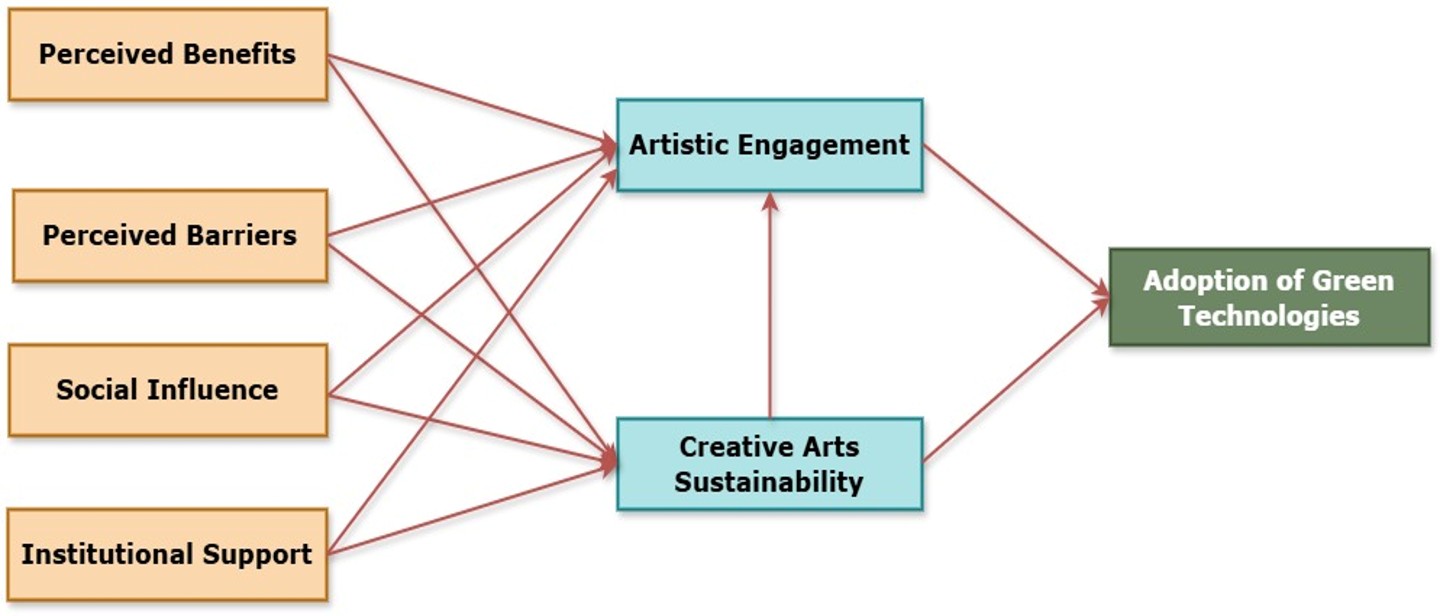 Figure 1
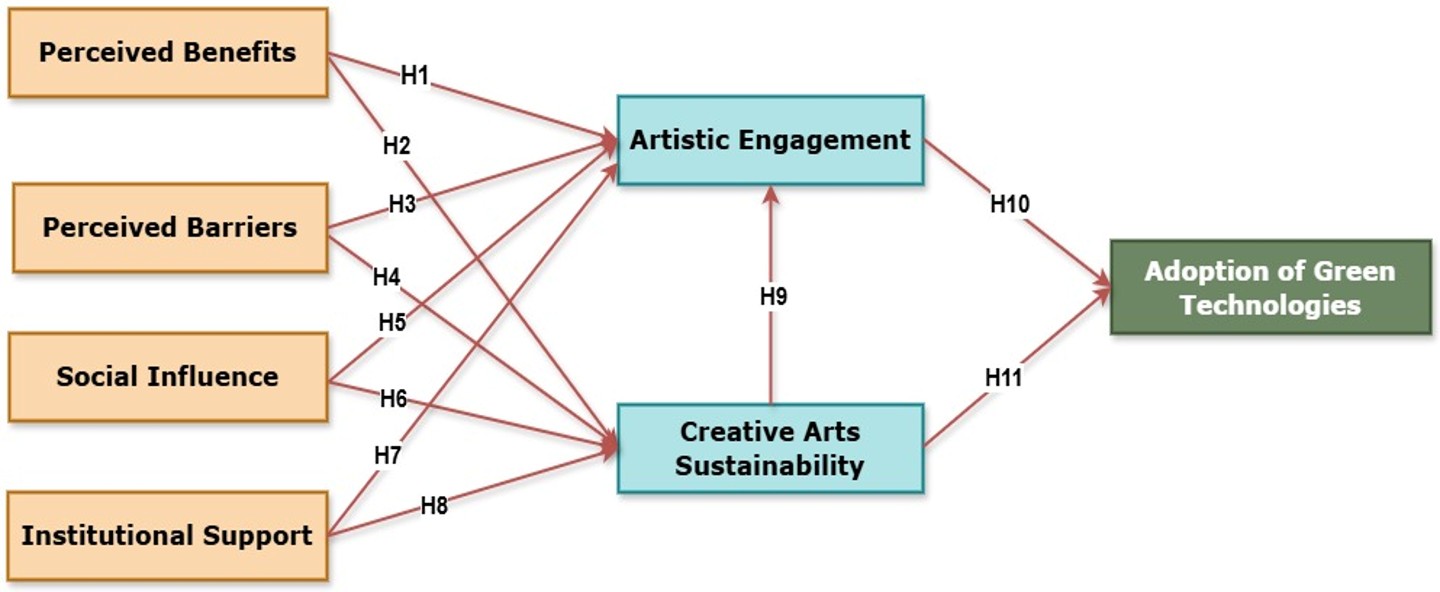 Figure 2
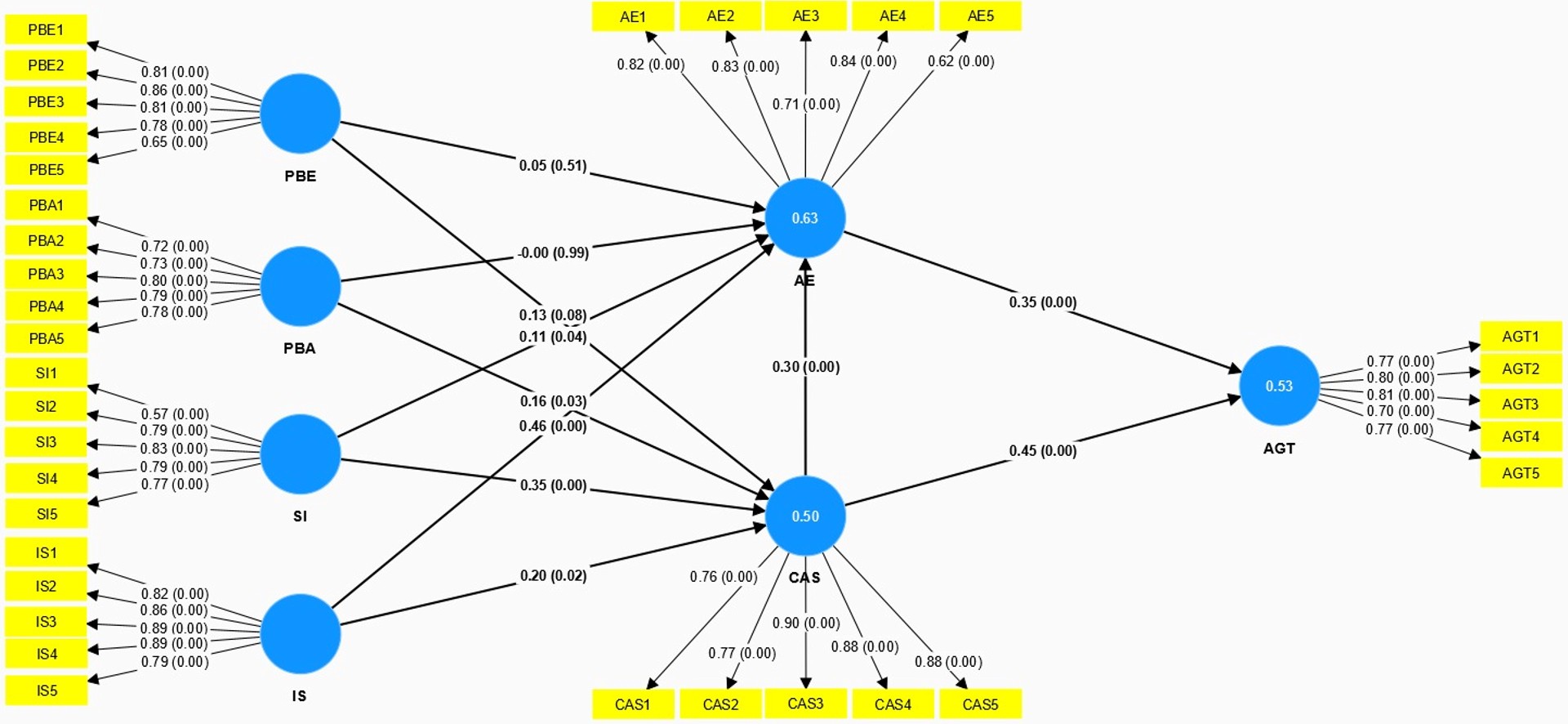 Figure 3
Keywords
Copyright © 2025
Al-Rahmi. This article is distributed under the terms of the Creative Commons Attribution License (CC BY 4.0), which permits unrestricted use and distribution provided that the original work is properly cited.
Funding
This research received no specific grant from any funding agency in the public, commercial, or not-for-profit sectors.
Cite this Article
Al-Rahmi, W. M. (2025). Sustainable Development Goals (SDGs) in Academia: Investigating the Drivers and Barriers of Green Technology Adoption among Students. Highlights of Sustainability, 4(4), 329–352. https://doi.org/10.54175/hsustain4040019
References
1.
Bukchin, S., & Kerret, D. (2020). Once you choose hope: early adoption of green technology. Environmental Science and Pollution Research, 27(3), 3271–3280. https://doi.org/10.1007/s11356-019-07251-y
2.
Suryawanshi, K., & Narkhede, S. (2015). Green ICT for sustainable development: A higher education perspective. Procedia Computer Science, 70, 701–707. https://doi.org/10.1016/j.procs.2015.10.107
3.
Chang, J., Li, B., Chen, B., Shen, Y., Lv, X., & Liu, J. (2023). Does higher education promote sustainable development? Role of green technology and financial performance. Environmental Science and Pollution Research, 30(41), 94890–94903. https://doi.org/10.1007/s11356-023-28927-6
4.
Cohen, M. C., Perakis, G., & Thraves, C. (2015). Competition and externalities in green technology adoption. SSRN. https://doi.org/10.2139/ssrn.2607688
5.
Aithal, P. S., & Rao, P. (2016). Green education concepts & strategies in higher education model. International Journal of Scientific Research and Modern Education, 1, 793–802.
6.
Fu, Y., Kok, R. A., Dankbaar, B., Ligthart, P. E., & van Riel, A. C. (2018). Factors affecting sustainable process technology adoption: A systematic literature review. Journal of Cleaner Production, 205, 226–251. https://doi.org/10.1016/j.jclepro.2018.08.268
7.
Aithal, S., & Aithal, S. (2016). Opportunities & challenges for green technology in 21st century. International Journal of Current Research and Modern Education, 1, 818–828.
8.
Ghanem, A. M., & Alamri, Y. A. (2023). The impact of the green Middle East initiative on sustainable development in the Kingdom of Saudi Arabia. Journal of the Saudi Society of Agricultural Sciences, 22(1), 35–46. https://doi.org/10.1016/j.jssas.2022.06.001
9.
Hernandez, A. A. (2017). Green IT adoption practices in education sector: a developing country perspective. International Journal of Sociotechnology and Knowledge Development, 9(3), 1–16. https://doi.org/10.4018/IJSKD.2017070101
10.
Tushi, B., Sedera, D., & Recker, J. (2014). Green IT segment analysis an academic literature review. AMCIS 2014 Proceedings (pp. 1–15). Association for Information Systems.
11.
Hosseini, S. E., Andwari, A. M., Wahid, M. A., & Bagheri, G. (2013). A review on green energy potentials in Iran. Renewable and Sustainable Energy Reviews, 27, 533–545. https://doi.org/10.1016/j.rser.2013.07.015
12.
Kahia, M., Omri, A., & Jarraya, B. (2021). Green energy, economic growth and environmental quality nexus in Saudi Arabia. Sustainability, 13(3), 1264. https://doi.org/10.3390/su13031264
13.
Albanawi, N. I. (2015). Saudi Arabian green economy infrastructure: Barriers, strategies & opportunity-an analysis. International Journal of Business and Economic Development (IJBED), 3, 3.
14.
Kahouli, B., Hamdi, B., Nafla, A., & Chabaane, N. (2022). Investigating the relationship between ICT, green energy, total factor productivity, and ecological footprint: Empirical evidence from Saudi Arabia. Energy Strategy Reviews, 42, 100871. https://doi.org/10.1016/j.esr.2022.100871
15.
Waheed, R. (2023). Energy challenges, green growth, blue indicators, and sustainable economic growth: a study of Saudi Arabia. Evaluation Review, 47(6), 983–1024. https://doi.org/10.1177/0193841X221134653
16.
Sayaf, A. M., Alamri, M. M., Alqahtani, M. A., & Alrahmi, W. M. (2022). Factors influencing university students’ adoption of digital learning technology in teaching and learning. Sustainability, 14(1), 493. https://doi.org/10.3390/su14010493
17.
Gholami, R., Sulaiman, A. B., Ramayah, T., & Molla, A. (2013). Senior managers’ perception on green information systems (IS) adoption and environmental performance: Results from a field survey. Information & Management, 50(7), 431–438. https://doi.org/10.1016/j.im.2013.01.004
18.
Tushi, B. T. (2015). An archival analysis of green information technology: The current state and future directions [Doctoral dissertation, Queensland University of Technology]. QUT ePrints.
19.
Hsu, C. L., Chen, M. C., & Lin, Y. H. (2017). Information technology adoption for sustainable development: green e-books as an example. Information Technology for Development, 23(2), 261–280. https://doi.org/10.1080/02681102.2017.1298078
20.
Issa, T., Issa, T., & Chang, V. (2014). Sustainability and green IT education: Practice for incorporating in the Australian higher education curriculum. The International Journal of Sustainability Education, 9(2), 19–30.
21.
Anthony Jnr, B. (2021). Green campus paradigms for sustainability attainment in higher education institutions–a comparative study. Journal of Science and Technology Policy Management, 12(1), 117–148. https://doi.org/10.1108/JSTPM-02-2019-0008
22.
Hottenrott, H., Rexhäuser, S., & Veugelers, R. (2016). Organisational change and the productivity effects of green technology adoption. Resource and Energy Economics, 43, 172–194. https://doi.org/10.1016/j.reseneeco.2016.01.004
23.
Xia, D., Zhang, M., Yu, Q., & Tu, Y. (2019). Developing a framework to identify barriers of green technology adoption for enterprises. Resources, Conservation and Recycling, 143, 99–110. https://doi.org/10.1016/j.resconrec.2018.12.022
24.
Sedera, D., Lokuge, S., Tushi, B., & Tan, F. (2017). Multi-disciplinary green IT archival analysis: A pathway for future studies. Communications of the Association for Information Systems, 41(1), 28. https://doi.org/10.17705/1CAIS.04128
25.
Smith, C., Hill, A. K., & Torrente-Murciano, L. (2020). Current and future role of Haber–Bosch ammonia in a carbon-free energy landscape. Energy & Environmental Science, 13(2), 331–344. https://doi.org/10.1039/C9EE02873K
26.
Jacobson, M. Z., & Archer, C. L. (2012). Saturation wind power potential and its implications for wind energy. Proceedings of the National Academy of Sciences, 109(39), 15679–15684. https://doi.org/10.1073/pnas.1208993109
27.
Zhou, F., Li, L., Zhang, K., Trajcevski, G., Yao, F., Huang, Y., et al. (2020). Forecasting the evolution of hydropower generation. Proceedings of the 26th ACM SIGKDD International Conference on Knowledge Discovery & Data Mining (pp. 2861–2870). Association for Computing Machinery. https://doi.org/10.1145/3394486.3403337
28.
Pretty, J., Benton, T. G., Bharucha, Z. P., Dicks, L. V., Flora, C. B., Godfray, H. C. J., et al. (2018). Global assessment of agricultural system redesign for sustainable intensification. Nature Sustainability, 1(8), 441–446. https://doi.org/10.1038/s41893-018-0114-0
29.
Kaza, S., & Bhada-Tata, P. (2019). Decision maker’s guides for solid waste management technologies. Urban Development Series Knowledge Papers. World Bank. https://doi.org/10.1596/31694
30.
Zhang, Z., Ding, T., Zhou, Q., Sun, Y., Qu, M., Zeng, Z., et al. (2021). A review of technologies and applications on versatile energy storage systems. Renewable and Sustainable Energy Reviews, 148, 111263. https://doi.org/10.1016/j.rser.2021.111263
31.
Samaras, C., & Meisterling, K. (2008). Life cycle assessment of greenhouse gas emissions from plug-in hybrid vehicles: implications for policy. Environmental Science & Technology, 42, 3170–3176. https://doi.org/10.1021/es702178s
32.
Negash, Y. T., & Filketu, S. A. (2022). A hierarchical framework for the transition to sustainable manufacturing practices: technical and social developments drive eco-friendly tanning in Ethiopia. Journal of Cleaner Production, 368, 133208. https://doi.org/10.1016/j.jclepro.2022.133208
33.
Stavins, R. N. (2022). The relative merits of carbon pricing instruments: Taxes versus trading. Review of Environmental Economics and Policy, 16(1), 62–82. https://doi.org/10.1086/717773
34.
Fischer, C., Preonas, L., & Newell, R. G. (2017). Environmental and technology policy options in the electricity sector: are we deploying too many? Journal of the Association of Environmental and Resource Economists, 4(4), 959–984. https://doi.org/10.1086/692507
35.
Martin, P., Bouty, C., Barbottin, A., & Le Bail, M. (1–4 April 2014). Diversifying strategies of agricultural cooperatives towards agro-ecological transition. 11th European IFSA Symposium: Farming systems facing global challenges: Capacities and strategies, Berlin, Germany.
36.
Scully-Russ, E., & Torraco, R. (2020). The changing nature and organization of work: An integrative review of the literature. Human Resource Development Review, 19(1), 66–93. https://doi.org/10.1177/1534484319886394
37.
Solis, M., Davies, W., & Randall, A. (2022). Climate justice pedagogies in green building curriculum. Curriculum Inquiry, 52(2), 235–249. https://doi.org/10.1080/03626784.2022.2041981
38.
Davis, J., & Davis, J. (2021). Probing the gap between policy and practice in initial early childhood teacher education in Australia in relation to education for sustainability. Asia-Pacific Journal of Teacher Education, 49(5), 550–565. https://doi.org/10.1080/1359866X.2021.1880545
39.
Cooper, K. J., & Gibson, R. B. (2022). A novel framework for inner-outer sustainability assessment. Challenges, 13(2), 64. https://doi.org/10.3390/challe13020064
40.
Campbell-Montalvo, R., Campbell, T., Park, B. Y., Arnold, C., Volin, J. C., Chrysochoou, M., & Diplock, P. C. (2021). E-corps’ implementation of environmental sustainability-focused service-learning: Conditions supporting the establishment of an epistemic community. The Journal of STEM Outreach, 4(1), 1–12. https://doi.org/10.15695/jstem/v4i1.12
41.
Madkhali, A., & Sithole, S. T. (2023). Exploring the role of information technology in supporting sustainability efforts in Saudi Arabia. Sustainability, 15(16), 12375. https://doi.org/10.3390/su151612375
42.
Bandi, R. K., Bose, A. K., & Saxena, A. (2015, June). Exploring green IT awareness and adoption among Indian students. Proceedings of the 2015 ACM SIGMIS Conference on Computers and People Research (pp. 87–96). Association for Computing Machinery. https://doi.org/10.1145/2751957.2751964
43.
Lay, G. C., Ahmad, R., & Ming, B. H. (2017). The barriers to adoption of green technology by higher education institutions in Malaysia. MOJEM: Malaysian Online Journal of Educational Management, 1(3), 23–34.
44.
Guo, M., Nowakowska-Grunt, J., Gorbanyov, V., & Egorova, M. (2020). Green technology and sustainable development: Assessment and green growth frameworks. Sustainability, 12(16), 6571. https://doi.org/10.3390/su12166571
45.
Davis, F. D. (1989). Perceived usefulness, perceived ease of use, and user acceptance of information technology. MIS Quarterly, 319–340.
46.
Lin, C. Y., & Ho, Y. H. (2011). Determinants of green practice adoption for logistics companies in China. Journal of Business Ethics, 98(1), 67–83. https://doi.org/10.1007/s10551-010-0535-9
47.
Ajzen, I. (1985). From Intentions to Actions: A Theory of Planned Behavior. In J. Kuhl & J. Beckmann (Eds.), Action Control (pp. 11–39). SSSP Springer Series in Social Psychology. Springer, Berlin, Heidelberg. https://doi.org/10.1007/978-3-642-69746-3_2
48.
Rogers, E. M. (1995). Diffusion of innovations (4th ed., vol. 12). The Free Press.
49.
Gao, R., Zhang, H., Gong, C., & Wu, Z. (2022). The role of farmers’ green values in creation of green innovative intention and green technology adoption behavior: Evidence from farmers grain green production. Frontiers in Psychology, 13, 980570. https://doi.org/10.3389/fpsyg.2022.980570
50.
Aboelmaged, M. G. (2014). Predicting e-readiness at firm-level: An analysis of technological, organizational and environmental (TOE) effects on e-maintenance readiness in manufacturing firms. International Journal of Information Management, 34(5), 639–651. https://doi.org/10.1016/j.ijinfomgt.2014.05.002
51.
Carlet, F. (2015). Understanding attitudes toward adoption of green infrastructure: A case study of US municipal officials. Environmental Science & Policy, 51, 65–76. https://doi.org/10.1016/j.envsci.2015.03.007
52.
Guo, Z., Chen, X., & Zhang, Y. (2022). Impact of environmental regulation perception on farmers’ agricultural green production technology adoption: a new perspective of social capital. Technology in Society, 71, 102085. https://doi.org/10.1016/j.techsoc.2022.102085
53.
Shehawy, Y. M., Khan, S. M. F. A., & Madkhali, H. (2025). An integrated SEM-ESG framework for understanding consumer’s green technology adoption behavior. Journal of the Knowledge Economy, 16(2), 8887–8928. https://doi.org/10.1007/s13132-024-02231-1
54.
Straub, E. T. (2009). Understanding technology adoption: Theory and future directions for informal learning. Review of Educational Research, 79(2), 625–649. https://doi.org/10.3102/0034654308325896
55.
Thomson, S., & van Belle, J. P. (2015). Antecedents of green IT adoption in South African higher education institutions. Electronic Journal of Information Systems Evaluation, 18(2), 173–187.
56.
Bollinger, B. (2015). Green technology adoption: An empirical study of the Southern California garment cleaning industry. Quantitative Marketing and Economics, 13(4), 319–358. https://doi.org/10.1007/s11129-015-9163-0
57.
Wang, X., Cho, S. H., & Scheller-Wolf, A. (2021). Green technology development and adoption: competition, regulation, and uncertainty—a global game approach. Management Science, 67(1), 201–219. https://doi.org/10.1287/mnsc.2019.3538
58.
Dezdar, S. (2017). Green information technology adoption: Influencing factors and extension of theory of planned behavior. Social Responsibility Journal, 13(2), 292–306. https://doi.org/10.1108/SRJ-05-2016-0064
59.
Nazari, G., & Karim, H. (2012). Green IT adoption: The impact of IT on environment: A case study on Green IT adoption and underlying factors influencing it. 2012 Proceedings of 17th Conference on Electrical Power Distribution (pp. 1–7). IEEE.
60.
Schmidt, N. H., Erek, K., Kolbe, L. M., & Zarnekow, R. (2010). Predictors of green IT adoption: Implications from an empirical investigation. Göttinger Wirtschaftsinformatik, 129.
61.
Molla, A., Cooper, V., Corbitt, B., Deng, H., Peszynski, K., Pittayachawan, S., et al. (2008). E-readiness to G-readiness: Developing a green information technology readiness framework. Proceedings of the 19th Australasian Conference on Information Systems 2008 (pp. 669–678). AIS Electronic Library (AISeL).
62.
Petzer, C., McGibbon, C., & Brown, I. (2011). Adoption of Green IS in South Africa: an exploratory study. Proceedings of the South African Institute of Computer Scientists and Information Technologists Conference on Knowledge, Innovation and Leadership in a Diverse, Multidisciplinary Environment (pp. 330–333). Association for Computing Machinery. https://doi.org/10.1145/2072221.2072270
63.
Ahn, Y. H., Pearce, A. R., Wang, Y., & Wang, G. (2013). Drivers and barriers of sustainable design and construction: The perception of green building experience. International Journal of Sustainable Building Technology and Urban Development, 4(1), 35–45. https://doi.org/10.1080/2093761X.2012.759887
64.
Murugesan, S., & Gangadharan, G. R. (2012). Green IT: an overview. Harnessing green IT: Principles and practices (pp. 1–21). Wiley. https://doi.org/10.1002/9781118305393.ch1
65.
Murugesan, S., & Gangadharan, G. R. (2012). Managing Green IT. Harnessing green IT: Principles and practices (pp. 283–296). Wiley. https://doi.org/10.1002/9781118305393.ch14
66.
Molla, A., & Abareshi, A. (2012). Organizational green motivations for information technology: empirical study. Journal of Computer Information Systems, 52(3), 92–102. https://doi.org/10.1080/08874417.2012.11645562
67.
Chow, W. S., & Chen, Y. (2009). Intended belief and actual behavior in green computing in Hong Kong. Journal of Computer Information Systems, 50(2), 136–141. https://doi.org/10.1080/08874417.2009.11645392
68.
Bazkiaei, H. A. (2020). Attitude towards entrepreneurship on the relationship between psychological and educational factors with entrepreneurial intention among university students [Doctoral dissertation]. Universiti Teknologi Malaysia.
69.
Mouakket, S., & Aboelmaged, M. (2023). Factors influencing green information technology adoption: A multi-level perspective in emerging economies context. Information Development, 39(4), 699–719. https://doi.org/10.1177/02666669211048489
70.
Wang, Y., Chong, D., & Liu, X. (2021). Evaluating the critical barriers to green construction technologies adoption in China. Sustainability, 13(12), 6510. https://doi.org/10.3390/su13126510
71.
Inwood, H., & Taylor, R. (2012). Creative approaches to environmental learning: Two perspectives on teaching environmental art education. International Electronic Journal of Environmental Education, 2(1), 65–75.
72.
Dahri, N. A., Vighio, M. S., Bather, J. D., & Arain, A. A. (2021). Factors influencing the acceptance of mobile collaborative learning for the continuous professional development of teachers. Sustainability, 13(23), 13222. https://doi.org/10.3390/su132313222
73.
Dessart, L., Veloutsou, C., & Morgan-Thomas, A. (2016). Capturing consumer engagement: duality, dimensionality and measurement. Journal of Marketing Management, 32(5–6), 399–426. https://doi.org/10.1080/0267257X.2015.1130738
74.
Ahmad, A. S., Hassan, M. Y., Abdullah, H., Rahman, H. A., Majid, M. S., & Bandi, M. (2012). Energy efficiency measurements in a Malaysian public university. 2012 IEEE International Conference on Power and Energy (PECon) (pp. 582–587). IEEE. https://doi.org/10.1109/PECon.2012.6450281
75.
Zakaria, R., Alqaifi, G., Rahim, A., Hamid, A. R. A., Mansur, S. A., Resang, A., et al. (2016). UTM sustainable living laboratory campus; Are the implementations effective. Proceedings of the Regional Conference in Engineering Education (pp. 215–220). Universiti Teknologi Malaysia.
76.
Hall, E., Wood, A., Ruck Keene, H., & White, H. (2021). The arts and education for sustainable development. Teaching the Arts in the Primary Curriculum. Exeter: Learning Matters (pp. 21–30). SAGE.
77.
KK, S., & Maskari, A. A. (2019). Student engagement in blended learning instructional design: An analytical study. Learning and Teaching in Higher Education: Gulf Perspectives, 15(2), 61–79. https://doi.org/10.18538/lthe.v15.n2.283
78.
Fan, S., Chen, L., Nair, M., Garg, S., Yeom, S., Kregor, G., et al. (2021). Revealing impact factors on student engagement: Learning analytics adoption in online and blended courses in higher education. Education Sciences, 11(10), 608. https://doi.org/10.3390/educsci11100608
79.
Hair, J. F., Black, W. C., & Babin, B. J. (2010). Multivariate data analysis: A global perspective. Pearson.
80.
Kock, N., & Hadaya, P. (2018). Minimum sample size estimation in PLS‐SEM: The inverse square root and gamma‐exponential methods. Information Systems Journal, 28(1), 227–261. https://doi.org/10.1111/isj.12131
81.
Cohen, J. (1988). Statistical power analysis for the behavioral sciences. Academic press.
82.
Hair Jr, J. F., Hult, G. T. M., Ringle, C. M., & Sarstedt, M. (2021). A primer on partial least squares structural equation modeling (PLS-SEM). SAGE.
83.
Dahri, N. A., Yahaya, N., Al-Rahmi, W. M., Almogren, A. S., & Vighio, M. S. (2024). Investigating factors affecting teachers’ training through mobile learning: Task technology fit perspective. Education and Information Technologies, 29(12), 14553–14589. https://doi.org/10.1007/s10639-023-12434-9
84.
Dahri, N. A., Yahaya, N., Al-Rahmi, W. M., Vighio, M. S., Alblehai, F., Soomro, R. B., et al. (2024). Investigating AI-based academic support acceptance and its impact on students’ performance in Malaysian and Pakistani higher education institutions. Education and Information Technologies, 29(14), 18695–18744. https://doi.org/10.1007/s10639-024-12599-x
85.
Kyriazos, T. A. (2018). Applied psychometrics: sample size and sample power considerations in factor analysis (EFA, CFA) and SEM in general. Psychology, 9(08), 2207.
86.
Tinsley, H. E., & Tinsley, D. J. (1987). Uses of factor analysis in counseling psychology research. Journal of Counseling Psychology, 34(4), 414–424.
87.
Wang, J., & Wang, X. (2019). Structural equation modeling: Applications using Mplus. John Wiley & Sons.
88.
Hair, J. F., Risher, J. J., Sarstedt, M., & Ringle, C. M. (2019). When to use and how to report the results of PLS-SEM. European Business Review, 31(1), 2–24. https://doi.org/10.1108/EBR-11-2018-0203
89.
Dash, G., & Paul, J. (2021). CB-SEM vs PLS-SEM methods for research in social sciences and technology forecasting. Technological Forecasting and Social Change, 173, 121092. https://doi.org/10.1016/j.techfore.2021.121092
90.
Jaya, I. G. M., Hermina, N., & Sunengsih, N. (2019). CB-SEM and VB-SEM: Evaluating measurement model of business strategy of internet industry in Indonesia. International Journal of Scientific & Engineering Research, 10(10), 878–883.
91.
Sarstedt, M., Ringle, C. M., & Hair, J. F. (2021). Partial least squares structural equation modeling. Handbook of market research (pp. 587–632). Cham: Springer.
92.
Hair Jr, J. F., Hult, G. T. M., Ringle, C. M., Sarstedt, M., Danks, N. P., & Ray, S. (2021). Partial least squares structural equation modeling (PLS-SEM) using R: A workbook. Springer Nature.
93.
Chin, W. W. (1998). The partial least squares approach to structural equation modeling. Modern methods for business research (pp. 295–336). Psychology Press.
94.
Henseler, J., Ringle, C. M., & Sarstedt, M. (2015). A new criterion for assessing discriminant validity in variance-based structural equation modeling. Journal of the Academy of Marketing Science, 43(1), 115–135. https://doi.org/10.1007/s11747-014-0403-8
95.
Abdullah, N., & Mohd Zahari, F. (2015). Social determinants of green technology adoption. In Proceedings of Symposium on Technology Management and Logistics (STMLGoGreen) (Vol. 8, No. 9). Universiti Utara Malaysia.
96.
Shahzad, M., Qu, Y., Rehman, S. U., & Zafar, A. U. (2022). Adoption of green innovation technology to accelerate sustainable development among manufacturing industry. Journal of Innovation & Knowledge, 7(4), 100231. https://doi.org/10.1016/j.jik.2022.100231
97.
Hair, J., Hollingsworth, C. L., Randolph, A. B., & Chong, A. Y. L. (2017). An updated and expanded assessment of PLS-SEM in information systems research. Industrial Management & Data Systems, 117(3), 442–458. https://doi.org/10.1108/IMDS-04-2016-0130
98.
Hair, J. F., Sarstedt, M., Ringle, C. M., & Mena, J. A. (2012). An assessment of the use of partial least squares structural equation modeling in marketing research. Journal of the Academy of Marketing Science, 40(3), 414–433. https://doi.org/10.1007/s11747-011-0261-6
99.
Raffaghelli, J. E., Rodríguez, M. E., Guerrero-Roldán, A. E., & Baneres, D. (2022). Applying the UTAUT model to explain the students’ acceptance of an early warning system in Higher Education. Computers & Education, 182, 104468. https://doi.org/10.1016/j.compedu.2022.104468
100.
Fornell, C., & Larcker, D. F. (1981). Structural equation models with unobservable variables and measurement error: Algebra and statistics. Journal of Marketing Research, 18(3), 382–388. https://doi.org/10.1177/002224378101800313
101.
Foroughi, B., Senali, M. G., Iranmanesh, M., Khanfar, A., Ghobakhloo, M., Annamalai, N., et al. (2024). Determinants of intention to use ChatGPT for educational purposes: Findings from PLS-SEM and fsQCA. International Journal of Human–Computer Interaction, 40(17), 4501–4520. https://doi.org/10.1080/10447318.2023.2226495
102.
Al-Rahmi, W. M., Al-Adwan, A. S., Al-Maatouk, Q., Othman, M. S., Alsaud, A. R., Almogren, A. S., & Al-Rahmi, A. M. (2023). Integrating communication and task–technology fit theories: The adoption of digital media in learning. Sustainability, 15(10), 8144. https://doi.org/10.3390/su15108144
103.
Almulla, M. A., & Al-Rahmi, W. M. (2023). Integrated social cognitive theory with learning input factors: The effects of problem-solving skills and critical thinking skills on learning performance sustainability. Sustainability, 15(5), 3978. https://doi.org/10.3390/su15053978
104.
Tawafak, R. M., Alyoussef, I. Y., & Al-Rahmi, W. M. (2023). Essential Factors to Improve Student Performance Using an E-Learning Model: Review Study. International Journal of Interactive Mobile Technologies, 17(3). https://doi.org/10.3991/ijim.v17i03.35727
105.
Mangla, S. K., Govindan, K., & Luthra, S. (2017). Prioritizing the barriers to achieve sustainable consumption and production trends in supply chains using fuzzy Analytical Hierarchy Process. Journal of Cleaner Production, 151, 509–525. https://doi.org/10.1016/j.jclepro.2017.02.099
106.
Lubberink, R., Blok, V., Van Ophem, J., & Omta, O. (2017). Lessons for responsible innovation in the business context: A systematic literature review of responsible, social and sustainable innovation practices. Sustainability, 9(5), 721. https://doi.org/10.3390/su9050721
107.
Alqahtani, M. A., Alamri, M. M., Sayaf, A. M., & Al-Rahmi, W. M. (2022). Exploring student satisfaction and acceptance of e-learning technologies in Saudi higher education. Frontiers in Psychology, 13, 939336. https://doi.org/10.3389/fpsyg.2022.939336
108.
Rhoades, L., & Eisenberger, R. (2002). Perceived organizational support: a review of the literature. Journal of Applied Psychology, 87(4), 698–714.
109.
Ramus, C. A. (2001). Organizational support for employees: Encouraging creative ideas for environmental sustainability. California Management Review, 43(3), 85–105. https://doi.org/10.2307/41166090
110.
Dahri, N. A., Vighio, M. S., Al-Rahmi, W. M., & Alismaiel, O. A. (2022). Usability Evaluation of Mobile App for the Sustainable Professional Development of Teachers. International Journal of Interactive Mobile Technologies, 16(16), 4–30. https://doi.org/10.3991/ijim.v16i16.32015
111.
Al-Rahmi, A. M., Shamsuddin, A., Wahab, E., Al-Rahmi, W. M., Alturki, U., Aldraiweesh, A., & Almutairy, S. (2022). Integrating the role of UTAUT and TTF model to evaluate social media use for teaching and learning in higher education. Frontiers in Public Health, 10, 905968. https://doi.org/10.3389/fpubh.2022.905968
112.
Al-Rahmi, A. M., Shamsuddin, A., Wahab, E., Al-Rahmi, W. M., Alismaiel, O. A., & Crawford, J. (2022). Social media usage and acceptance in higher education: A structural equation model. Frontiers in Education, 7, 964456. https://doi.org/10.3389/feduc.2022.964456
113.
Begum, S., Xia, E., Ali, F., Awan, U., & Ashfaq, M. (2022). Achieving green product and process innovation through green leadership and creative engagement in manufacturing. Journal of Manufacturing Technology Management, 33(4), 656–674. https://doi.org/10.1108/JMTM-01-2021-0003
114.
Saunila, M., Rantala, T., Ukko, J., & Havukainen, J. (2019). Why invest in green technologies? Sustainability engagement among small businesses. Technology Analysis & Strategic Management, 31(6), 653–666. https://doi.org/10.1080/09537325.2018.1542671
115.
Dahri, N. A., Vighio, M. S., Alismaiel, O. A., & Al-Rahmi, W. M. (2022). Assessing the Impact of Mobile-Based Training on Teachers’ Achievement and Usage Attitude. International Journal of Interactive Mobile Technologies, 16(9), 107–129. https://doi.org/10.3991/ijim.v16i09.30519
116.
D’Amato, A., Mazzanti, M., & Nicolli, F. (2021). Green technologies and environmental policies for sustainable development: Testing direct and indirect impacts. Journal of Cleaner Production, 309, 127060. https://doi.org/10.1016/j.jclepro.2021.127060
117.
Zhang, Y., Sun, J., Yang, Z., & Wang, Y. (2020). Critical success factors of green innovation: Technology, organization and environment readiness. Journal of Cleaner Production, 264, 121701. https://doi.org/10.1016/j.jclepro.2020.121701
118.
Shahadat, M. H., Nekmahmud, M., Ebrahimi, P., & Fekete-Farkas, M. (2023). Digital technology adoption in SMEs: what technological, environmental and organizational factors influence in emerging countries? Global Business Review. https://doi.org/10.1177/09721509221137199
119.
Jnr, B. A., Majid, M. A., & Romli, A. (2018). A proposed model for green practice adoption and implementation in information technology based organizations. Problemy Ekorozwoju, 13(1), 95–112.
120.
Chan, A. P. C., Darko, A., Olanipekun, A. O., & Ameyaw, E. E. (2018). Critical barriers to green building technologies adoption in developing countries: The case of Ghana. Journal of Cleaner Production, 172, 1067–1079. https://doi.org/10.1016/j.jclepro.2017.10.235
121.
Loke, S-P., Khalizani, K., Rohati, S., & Sayaka, A. (2014). Drivers and barriers for going green: perceptions from the business practitioners in Malaysia. ASEAN Journal on Science and Technology for Development, 31(2), 49–61. https://doi.org/10.29037/ajstd.16
122.
Nowotny, J., Dodson, J., Fiechter, S., Gür, T. M., Kennedy, B., Macyk, W., et al. (2018). Towards global sustainability: Education on environmentally clean energy technologies. Renewable and Sustainable Energy Reviews, 81, 2541–2551. https://doi.org/10.1016/j.rser.2017.06.060
123.
Goldman, D., Ayalon, O., Baum, D., & Weiss, B. (2018). Influence of ‘green school certification’ on students’ environmental literacy and adoption of sustainable practice by schools. Journal of Cleaner Production, 183, 1300–1313. https://doi.org/10.1016/j.jclepro.2018.02.176
124.
Dwivedi, Y. K., Kshetri, N., Hughes, L., Slade, E. L., Jeyaraj, A., Kar, A. K., et al. (2023). Opinion Paper: “So what if ChatGPT wrote it?” Multidisciplinary perspectives on opportunities, challenges and implications of generative conversational AI for research, practice and policy. International Journal of Information Management, 71, 102642. https://doi.org/10.1016/j.ijinfomgt.2023.102642
125.
McKenzie‐Mohr, D. (2000). New ways to promote proenvironmental behavior: Promoting sustainable behavior: An introduction to community‐based social marketing. Journal of Social Issues, 56(3), 543–554. https://doi.org/10.1111/0022-4537.00183
126.
Al-Dmour, H. (2023). Green-smart university campuses: the mediating role of student engagement in enhancing corporate image. Sage Open, 13(4). https://doi.org/10.1177/21582440231219591
127.
Ajzen, I. (1991). The theory of planned behavior. Organizational Behavior and Human Decision Processes, 50(2), 179–211. https://doi.org/10.1016/0749-5978(91)90020-T
128.
Dahri, N. A., Al-Rahmi, W. M., Almogren, A. S., Yahaya, N., Vighio, M. S., & Al-Maatuok, Q. (2023). Mobile-based training and certification framework for teachers’ professional development. Sustainability, 15(7), 5839. https://doi.org/10.3390/su15075839
129.
Venkatesh, V., Thong, J. Y., & Xu, X. (2012). Consumer acceptance and use of information technology: extending the unified theory of acceptance and use of technology. MIS Quarterly, 157–178. https://doi.org/10.2307/41410412
130.
Burritt, R. L., Christ, K. L., Rammal, H. G., & Schaltegger, S. (2020). Multinational enterprise strategies for addressing sustainability: The need for consolidation. Journal of Business Ethics, 164(2), 389–410. https://doi.org/10.1007/s10551-018-4066-0
131.
Schaltegger, S., & Burritt, R. (2018). Business cases and corporate engagement with sustainability: Differentiating ethical motivations. Journal of Business Ethics, 147(2), 241–259. https://doi.org/10.1007/s10551-015-2938-0
Metrics
Loading...
Journal Menu
Journal Contact
Highlights of Sustainability
Editorial Office
Highlights of Science
Avenida Madrid, 189-195, 3-3
08014 Barcelona, Spain
08014 Barcelona, Spain
Ms.
Cathy Wang
Managing Editor
