
Article Peer-Reviewed
From Blue Economy to Blue Justice: Ensuring Inclusive Sustainability in Rawa Pening’s Resource Utilization
Department of Economics and Development Studies, Faculty of Economics and Business, Universitas Diponegoro, Tembalang, Semarang, Central Java 50275, Indonesia
*
For correspondence.
Academic Editor:

Received: 29 September 2025 Accepted: 11 February 2026 Published: 25 February 2026
Abstract
Rawa Pening, a crucial wetland ecosystem in Central Java, Indonesia, is facing significant challenges due to environmental degradation and resource overexploitation. While efforts under the blue economy and blue growth concepts have been implemented to enhance the region’s economic potential, these approaches have often led to socio-economic inequalities and ecological damage. this study aims to analyze the failures of blue economy and blue growth in managing rawa pening’s natural resources and to explore the application of blue justice as a more inclusive and sustainable alternative. utilizing in-depth interviews with 50 local stakeholders, including fishers, farmers, and water hyacinth harvesters, the research investigates issues such as unequal resource access, limited community participation, and the ecological impact of current management practices. the findings highlight the importance of adopting blue justice principles to ensure fair distribution of resources, empower marginalized communities, and promote environmental sustainability. This research suggests that integrating blue justice into Rawa Pening’s resource management could offer a pathway for achieving both ecological restoration and social equity, addressing the shortcomings of previous development models.
Figures in this Article
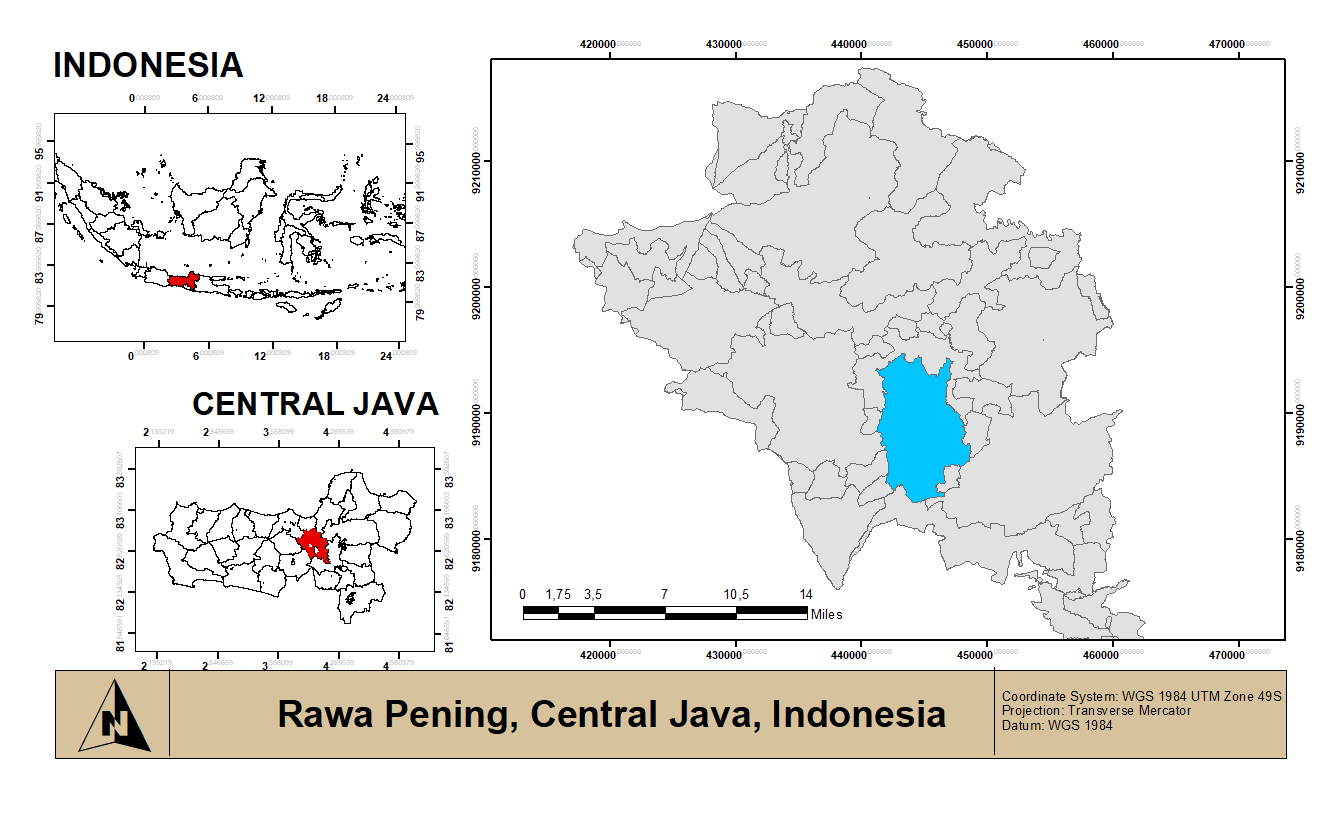 Figure 1
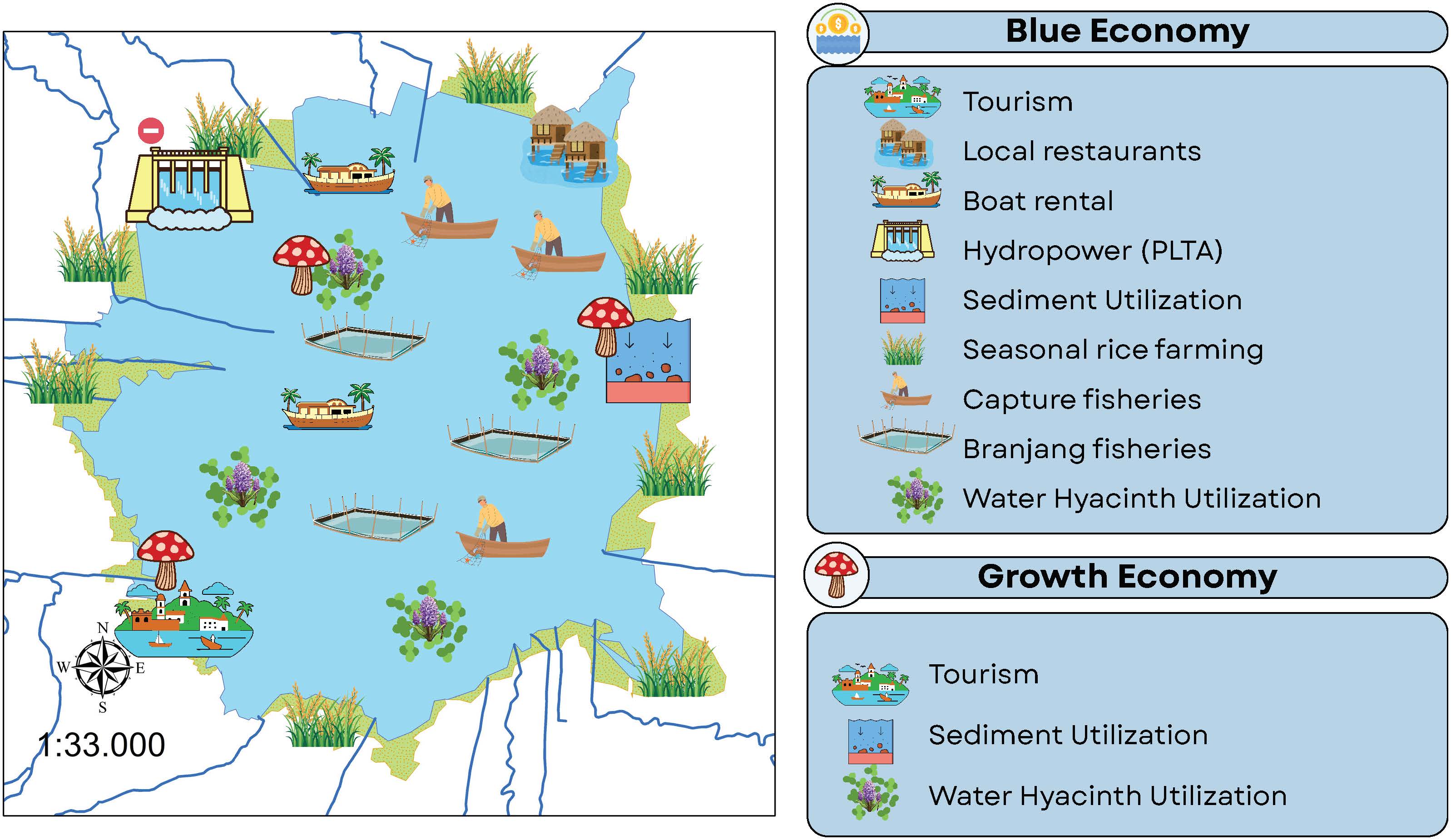 Figure 2
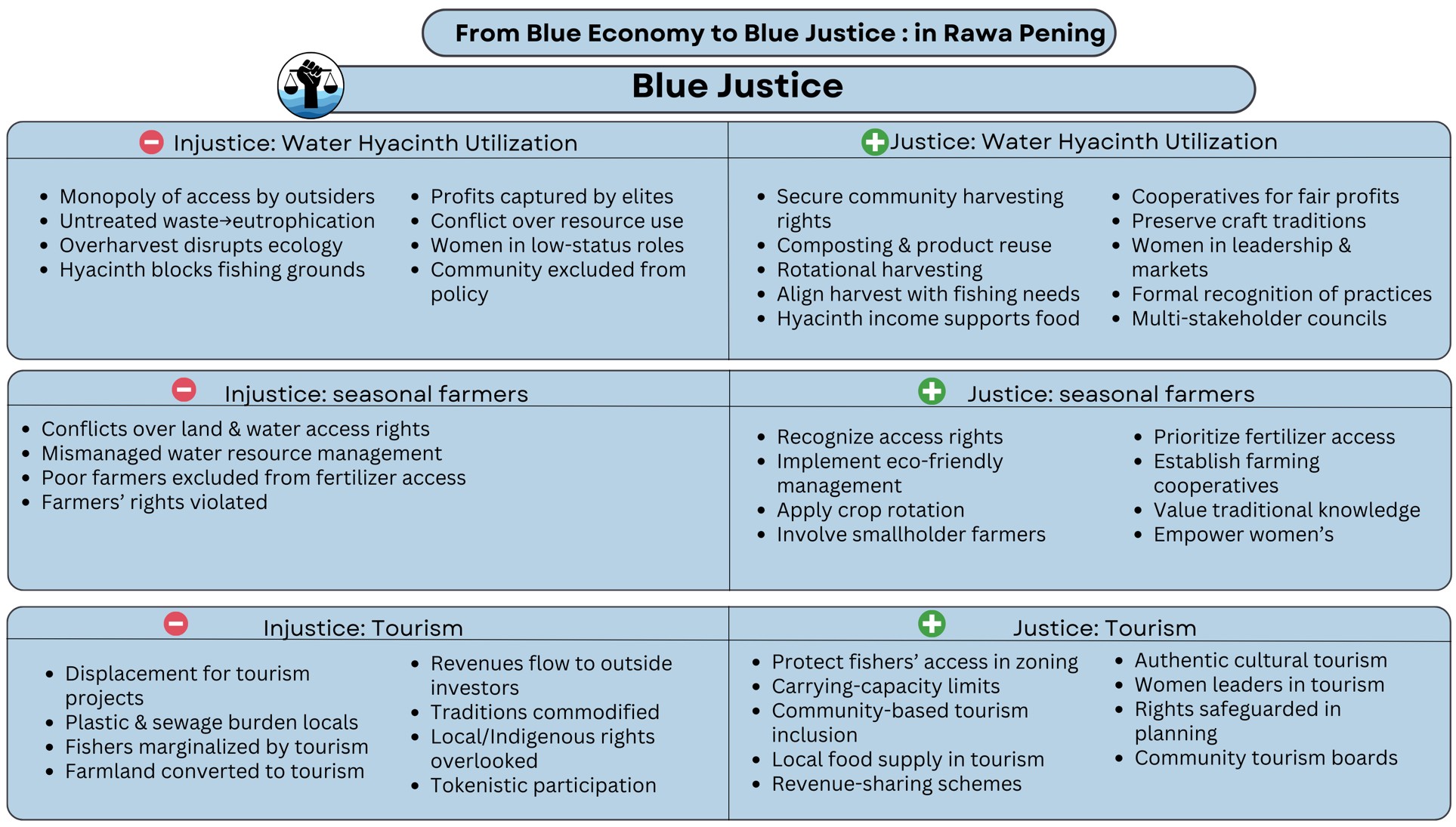 Figure 3
Keywords
Copyright © 2026
Waridin et al. This article is distributed under the terms of the Creative Commons Attribution License (CC BY 4.0), which permits unrestricted use and distribution provided that the original work is properly cited.
Funding
This research was funded by the Ministry of Education, Culture, Research, and Technology of the Republic of Indonesia through the Fundamental Regular Research Scheme, administered by the Institute for Research and Community Service (LPPM), Universitas Diponegoro, under Grant No. 359-011/UN7.D2.1/PP/VI/2025.
Cite this Article
Waridin, Al Hafidz, Z., Sumarjiyanto Benedictus Maria, N., Munasik, & Anggoro, J. (2026). From Blue Economy to Blue Justice: Ensuring Inclusive Sustainability in Rawa Pening’s Resource Utilization. Highlights of Sustainability, 5(1), 116–129. https://doi.org/10.54175/hsustain5010009
References
1.
Chuenpagdee, R., & Jentoft, S. (2025). Blue Justice principles for small-scale fisheries in marine protected areas. In L. B. Crowder (Ed.), Navigating Our Way to Solutions in Marine Conservation. Open Book Publishers.
2.
Leposa, N. (2020). Problematic blue growth: a thematic synthesis of social sustainability problems related to growth in the marine and coastal tourism. Sustainability Science, 15(4), 1233–1244. https://doi.org/10.1007/s11625-020-00796-9
3.
van Noort, C., Prall, M. C., Asif, F., & Coelho, N. F. (2026). Conceptualizing the interplay between blue justice, blue economy, and blue governance. Marine Policy, 184, 106939. https://doi.org/10.1016/j.marpol.2025.106939
4.
Bennett, N. J., Blythe, J., White, C. S., & Campero, C. (2021). Blue growth and blue justice: Ten risks and solutions for the ocean economy. Marine Policy, 125, 104387. https://doi.org/10.1016/j.marpol.2020.104387
5.
Ertör, I., & Hadjimichael, M. (2020). Editorial: Blue degrowth and the politics of the sea: rethinking the blue economy. Sustainability Science, 15(1), 1–10. https://doi.org/10.1007/s11625-019-00772-y
6.
Mallin, F., & Barbesgaard, M. (2020). Awash with contradiction: Capital, ocean space and the logics of the Blue Economy Paradigm. Geoforum, 113, 121–132. https://doi.org/10.1016/j.geoforum.2020.04.021
7.
Casadei, S., Pierleoni, A., & Bellezza, M. (2016). Integrated water resources management in a lake system: A case study in central Italy. Water, 8(12), 570. https://doi.org/10.3390/w8120570
8.
Mujiburohman, D. A., & Andari, D. W. T. (2023). Revitalization of Rawa Pening lake, Indonesia. Environment Conservation Journal, 24(2), 83–90. https://doi.org/10.36953/ECJ.14112421
9.
Akpalu, W., & Eggert, H. (2021). The economic, social and ecological performance of the industrial trawl fishery in Ghana: Application of the FPIs. Marine Policy, 125, 104241. https://doi.org/10.1016/j.marpol.2020.104241
10.
World Bank, & United Nations Department of Economic and Social Affairs. (2017). The Potential of the Blue Economy: Increasing Long-term Benefits of the Sustainable Use of Marine Resources for Small Island Developing States and Coastal Least Developed Countries. World Bank Group. https://doi.org/10.1596/26843
11.
Chuenpagdee, R. (2020). Blue Justice for Small-Scale Fisheries: What, why and how. In V. Kerezi, D. Pietruszka, & R. Chuenpagdee (Eds.), Blue Justice for Small-Scale Fisheries–A Global Scan (p. 3). TBTI Global Publication Series.
12.
OECD. (2016). The ocean economy in 2030. https://doi.org/10.1787/9789264251724-en
13.
Al-Hafidz, Z., Susilowati, I., Waridin, W., Maria, N. S. B., & Iskandar, D. D. (2024). Enhancing Livelihood Resilience: A Comprehensive Analysis of Small-Scale Fishers. Journal of Sustainability Research, 6(3), e240064. https://doi.org/10.20900/jsr20240064
14.
Hadjimichael, M. (2018). A call for a blue degrowth: Unravelling the European Union’s fisheries and maritime policies. Marine Policy, 94, 158–164. https://doi.org/10.1016/j.marpol.2018.05.007
15.
Ertör, I. (2023). ‘We are the oceans, we are the people!’: fisher people’s struggles for blue justice. Journal of Peasant Studies, 50(3), 1157–1186. https://doi.org/10.1080/03066150.2021.1999932
16.
Janssens de Bisthoven, L., Vanhove, M. P. M., Rochette, A. J., Hugé, J., Verbesselt, S., Machunda, R., et al. (2020). Social-ecological assessment of Lake Manyara basin, Tanzania: A mixed method approach. Journal of Environmental Management, 267, 110594. https://doi.org/10.1016/j.jenvman.2020.110594
17.
Antonova, A., Flannery, W., Gómez, S., Gustavsson, M., Hadjimichael, M., Murtagh, B., et al. (2025). Centering coastal communities’ diverse economic practices in the blue economy. Geoforum, 167, 104438. https://doi.org/10.1016/j.geoforum.2025.104438
18.
Pheifer, C., & Hill, C. (2024). Great Lakes wave energy resource classification and Blue Economy opportunities. Renewable Energy, 235, 121213. https://doi.org/10.1016/j.renene.2024.121213
19.
Engen, S., Hausner, V. H., Gurney, G. G., Broderstad, E. G., Keller, R., Lundberg, A. K., et al. (2021). Blue justice: A survey for eliciting perceptions of environmental justice among coastal planners’ and small-scale fishers in Northern-Norway. PLOS ONE, 16, e0251467. https://doi.org/10.1371/journal.pone.0251467
20.
Schreiber, M. A., Chuenpagdee, R., & Jentoft, S. (2022). Blue Justice and the co-production of hermeneutical resources for small-scale fisheries. Marine Policy, 137, 104959. https://doi.org/10.1016/j.marpol.2022.104959
21.
Ssekajja, G. (2024). Inherent Dilemma: Balancing conservation efficiency and social equity in natural resource governance. World Development, 179, 106621. https://doi.org/10.1016/j.worlddev.2024.106621
22.
Tang, Y., Liang, S., Bu, H., & Huang, R. (2025). Sustainable development in wetland tourism: The impacts of gratitude to nature and connectedness to nature on environmentally responsible behavior. Journal of Hospitality and Tourism Management, 63, 460–477. https://doi.org/10.1016/j.jhtm.2025.05.019
23.
Abba, A., & S, S. (2025). Sustainable management of water hyacinth (Eichhornia crassipes): Community-Led strategies for livelihood enhancement in rural India. Results in Engineering, 26, 105033. https://doi.org/10.1016/j.rineng.2025.105033
24.
Nega, D. T., Ancha, V. R., Manenti, F., & Adeel, Z. (2024). A comprehensive policy framework for unlocking the potential of water hyacinth in Ethiopia’s circular bioeconomy. Journal of Cleaner Production, 435, 140509. https://doi.org/10.1016/j.jclepro.2023.140509
25.
Henny, C., Julzarika, A., Sulastri, Prasetyo, S., Retno Utami, R., Setiadewi, N., et al. (2026). Recurring struggle in managing water hyacinth invasion and water quality in a tropical lake: Case study of Lake Rawa Pening, Indonesia. Journal of Environmental Management, 397, 128210. https://doi.org/10.1016/j.jenvman.2025.128210
26.
Tibebe, D., Kassa, Y., Biru, B., Aregahagne, S., Jember, K., Fentie, T., et al. (2025). Evaluating the nutrient content and heavy metal safety of water hyacinth-based compost: A sustainable solution for chemical fertilizer reduction and nutrient recycling in agriculture. Scientific African, 30, e02985. https://doi.org/10.1016/j.sciaf.2025.e02985
27.
Penca, J., Ertör, I., Ballesteros, M., Briguglio, M., Kowalewski, M., Pauksztat, B., et al. (2025). Rethinking the Blue Economy: Integrating social science for sustainability and justice. npj Ocean Sustainability, 4, 40. https://doi.org/10.1038/s44183-025-00138-1
28.
Fariz, T. R., Amalia, A. V., Atunnisa, R., & Jabbar, A. (2024). Estimation of changes in water quality parameters in Rawa Pening Lake based on remote sensing data. Indonesian Journal of Conservation, 13(1), 4372. https://doi.org/10.15294/ijc.v13i1.4372
29.
Lamsal, P., Pant, K. P., Kumar, L., & Atreya, K. (2015). Sustainable livelihoods through conservation of wetland resources: A case of economic benefits from Ghodaghodi Lake, western Nepal. Ecology and Society, 20(1), 10. https://doi.org/10.5751/ES-07172-200110
30.
Lee, K. H., Noh, J., Lee, J., & Khim, J. S. (2021). Blue economy and the total environment: Mapping the interface. Environment International, 157, 106796. https://doi.org/10.1016/j.envint.2021.106796
Sustainable Development Goals
This work contributes to the following Sustainable Development Goals (SDGs).


Journal Menu
Journal Contact
Highlights of Sustainability
Editorial Office
Highlights of Science
Avenida Madrid, 189-195, 3-3
08014 Barcelona, Spain
08014 Barcelona, Spain
Ms.
Cathy Wang
Managing Editor
